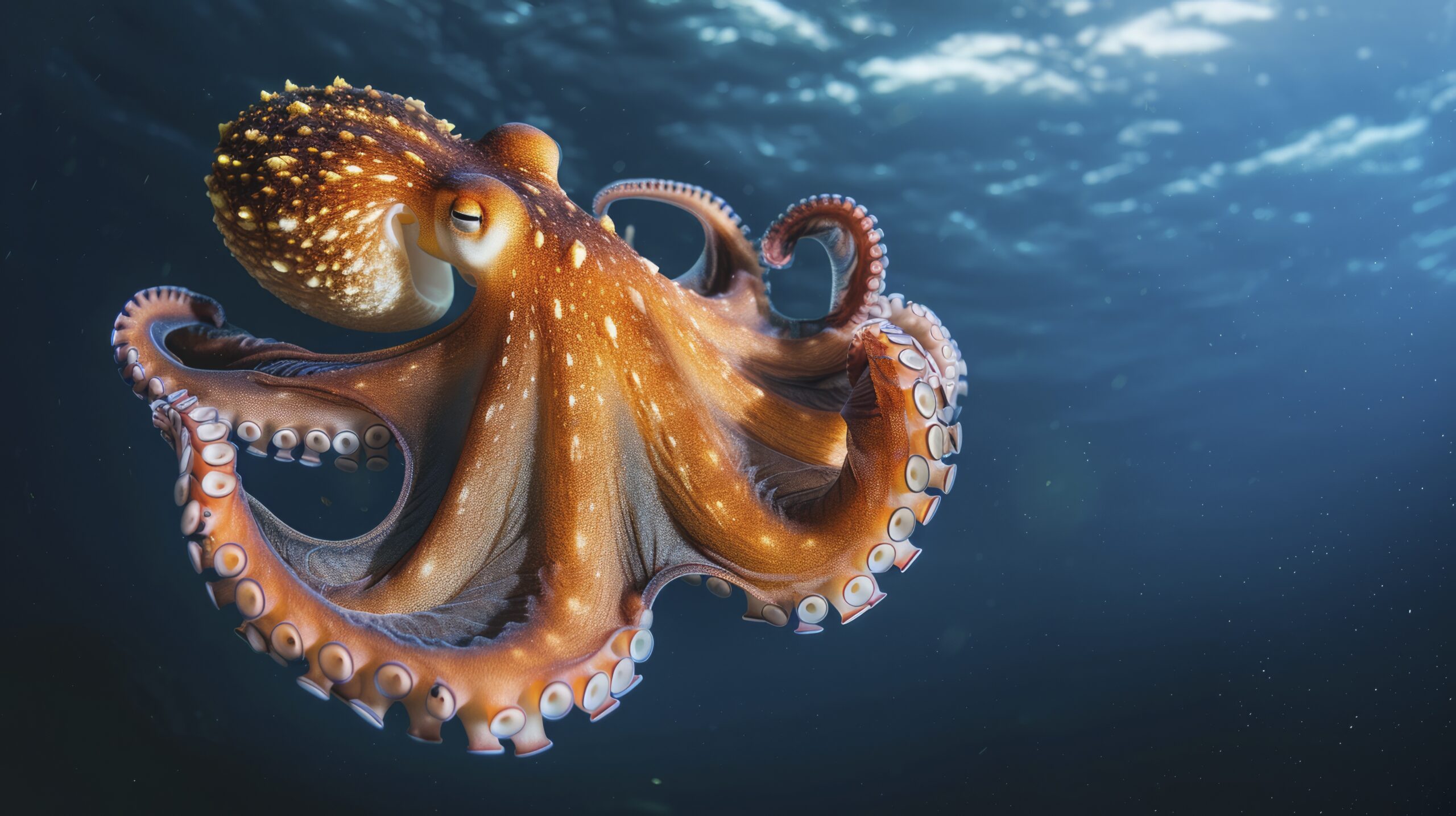
Why Is the Octopus Considered One of the Smartest Ocean Creatures?

Do you find learning about octopuses fascinating? They are among the ocean’s most interesting creatures. You will be amazed by their distinctive traits. They are quite intelligent. For instance, they can open jars, solve riddles, and even break out of aquarium tanks. They have the ability to right away change their texture, color, and pattern. They can even imitate other animals. For instance, flatfish and sea fish. They carry shells for safety and utilize coconut shells as a shelter. Additionally, only 10% of their neurons are located in the central brain; the remaining neurons are found in their arms. Their ability to study and even identify human faces is one of their unique and deeply complex characteristics.
How Do Octopuses Solve Problems in the Ocean?
According to the passage above, they have special abilities like the ability to open jars, get out of aquariums, and obtain food by navigating challenging environments. How can octopuses resolve issues in the ocean? That is the question at hand. They are able to address issues in the ocean because of their special qualities. Their arms have chemical sensors and are capable of acting on their own. While the main brain takes care of other things, they can search for prey in crevices or go around blocks. They have a lot of sensitive suckers on their eight arms. They are able to closely examine stuff. They can learn how to communicate with them. Because of this, they are regarded as the most intelligent marine creatures.
🔗 Learn more about amazing animal adaptations:
https://animalstudieslab.com/the-camel-the-ship-of-the-desert-explained/
How Do Octopuses Change Color to Hide From Predators?
Octopuses have elastic sacs filled with yellow, red, brown, and black pigments, which are controlled by their nerves. The time when their muscle contracts, the sac expands to show color, and when they get relaxed, it shrinks to a tiny dot, which helps the octopus to change patterns instantly. And this process is known as chromatophores. Octopuses are incredibly clever and skilled at hiding from predators. Their skin may create tiny ridges and bumps to look like rough rocks or coral surfaces because of the unique muscles in their bodies. Their camouflage in the ocean is quite successful due to the combination of color and texture changes. Additionally, their neurological system, which reacts fast to what the octopus senses in its environment, controls their camouflage. When a predator gets close, they quickly blend in with the surroundings, making it harder for the predator to spot the octopus. Likewise, this characteristic aids the octopus in both protecting itself from harm and capturing prey.
Where Do Octopus Live in the Ocean?
Octopuses can be found all over the world in a variety of oceanic environments, from the cold deep sea floor to shallow coastal tidal pools and coral reefs. For instance, Grimpoteuthis octopuses are found in the deep sea, which is around 7000 meters deep, while common octopuses like to be found in shallow waters, rough reefs, and seagrass beds. Meanwhile, there are underwater locations where octopuses stay, which are referred to as octopus sites. Japan is home to huge Pacific octopuses. Also, a lot of octopuses construct their dens, which are tiny homes. In other words, they are present in every ocean.

How Do Octopuses Reproduce and Care for Their Eggs?
During mating, the male octopus transfers spermatophores into the female’s mantle cavity using the hectocotylus, another unique characteristic of octopuses that is referred to as a third right arm. Octopuses are semelparous. They can only reproduce once before they die. A female may lay anywhere from thousands to over 100,000 eggs, depending on the species. In order to keep diseases like algae and parasites away from eggs, females touch and shield the eggs for months. After mating, male octopuses die, while some females pass away after laying and hatching their eggs. The female octopus loses weight as a result of not leaving their den to hunt or eat during this entire procedure. 🔗 Discover more fascinating animal facts: https://animalstudieslab.com/15-mind-blowing-facts-about-zebras-you-probably-didnt-know/
What Surprising Facts Do People Not Know About Octopus?
- Octopus blood is blue.
- They have three hearts. One heart helps them to pump blood to their body, and the other two hearts help them to pump blood to their gills.
- Octopuses have beaks like parrots.
- They have nine brains
- Their lifespan is so short, around 1-5 years.
- The blue-ringed octopus (Hapalochlaena) is one of the deadliest and most poisonous octopuses.
- The giant Pacific octopus is one of the smartest octopus species.
- The common octopus (Vulgaris) can be eaten and used in Atlantic dishes.
- Octopuses do not die out of water; they can survive for around 30-40 minutes.
- An octopus’s main heart stops beating when they swim
For more detailed information about octopus behavior and intelligence, visit Smithsonian Ocean – Octopus Facts: https://ocean.si.edu/ocean-life/invertebrates/octopus
Conclusion: Why Octopuses Are Important in the Ocean

Octopuses are genuinely amazing marine creatures distinguished by their intelligence, distinctive physical characteristics, and interesting habits. These animals show skills that set them apart from other marine life, like problem-solving, color change, and egg care. critically important because they contribute to the diversity and complexity of ocean life, preserve the natural balance of the ocean, provide a food supply for other species, and serve as an indication of the health of the ocean. They are crucial to marine systems and aid in the understanding of ocean biodiversity, animal intelligence, and camouflage by scientists.
📌 Discover 5 Amazing Octopus Facts on Pinterest!
https://in.pinterest.com/pin/1134484962400886400
FAQs
1. How intelligent are octopuses?
Among the most complex marine creatures are octopuses. They are able to open jars, solve riddles, get out of tanks, and recall answers.
2. Why do octopuses have blue blood?
Octopuses have blue blood because it contains hemocyanin, a copper-based protein that helps transport oxygen in cold and low-oxygen ocean environments.
3. What do octopuses eat?
Octopuses usually eat crabs, shrimp, fish, and small shellfish.
4. How do octopuses move in the water?
Octopuses move by crawling with their arms or by jet propulsion, pushing water out of their body to swim quickly.
5. Do octopuses have bones?
No, octopuses have soft bodies and no bones, which allows them to squeeze through very small spaces.
