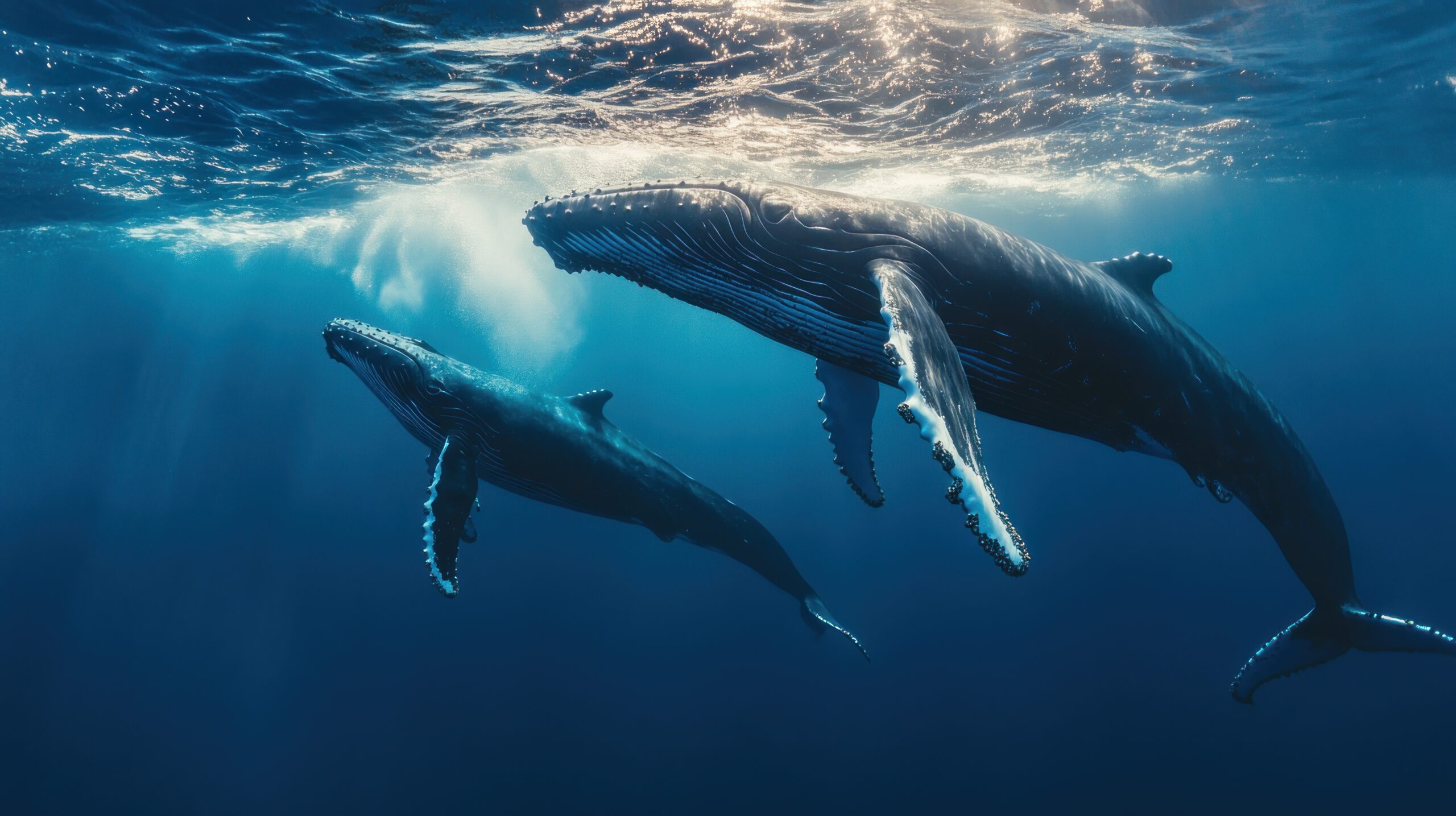
Whales are mammals, the largest living creatures on Earth. They travel across all of the world’s oceans, using complex and mysterious sounds to communicate. Whales contribute to the battle against climate change. They contribute significantly to the removal of carbon from the atmosphere; on average, each great whale is thought to sequester 33 tonnes of CO₂. When a whale dies and sinks to the deep ocean floor, it creates a ‘whale fall.’ The most haunting miracle of nature is when one death transforms into an entire ecosystem. As protectors of the oceanic domain, whales are essential to the delicate balance of our oceans.

For more animal and wildlife facts, visit:
https://animalstudieslab.com/snow-leopard-habitat-diet-physical-features-threats-and-conservation-status/
Whales characteristics and types
Whales fall into two major categories.
Baleen Whales
Baleen whales come in a variety of names, many of which you may already be familiar with.
- Blue whales—their heart is the size of a small car, weighing around 180 kg. They are in danger despite their little size. Blue whales consume some of the tiniest prey, consuming up to 4 tons of microscopic krill every day. Among the loudest sounds in nature are their calls. Many blue whales can live up to 80–90 years old, and some can survive up to 100. A newborn whale is already enormous, weighing close to three tons and standing approximately seven meters tall. Every year, blue whales travel a great distance.
- Humpback Whale—They have the longest pectoral fins of any whale species, reaching up to one-third of their body length. Similar to fingerprints, each whale’s tail fluke pattern is distinct, enabling researchers to identify certain whales. Even though they can weigh up to 40 tons, humpback whales can make amazing leaps out of the ocean. Thanks to conservation initiatives, humpback whale populations have recovered since commercial whaling ended. travel thousands of kilometers annually between tropical breeding waters and polar feeding sites.
- Antarctic minke whale—Compared to regular minke whales, Antarctic minke whales have bigger skulls. Their jaw contains roughly 380 symmetrical baleen plates that are utilized to filter food. There are between fifty and seventy throat grooves that enlarge during feeding. The minke, like all whales, needs to come to the surface in order to breathe through two blowholes. The Antarctic minke whale and the northern, or common, minke whale are their two recognized species. They can swim up to 34 kph, are very acrobatic and frequently active on the water’s surface, and are known to sing and interact with one another.
Toothed Whales
-
Sperm whales—Sperm whales are the largest toothed whale, up to 18 meters, and they have the biggest brain on Earth. They are deep-diving hunters, routinely going 1 to 2 kilometers deep for 45 to 90 minutes. Sperm whales have lower jaw teeth only, which interlock with the upper jaw’s square, blocky head. The whaling legacy, which once hunted for spermaceti oil, is protected today. Matriarchal pods, females and calves, stay in stable groups. Adult males roam to high latitudes. Sperm whales are masters of echolocation; among the loudest animal picks, tracked giant squid in the dark.
-
Orca, or killer whale—the orca whale is referred to as the ocean’s black and white predator. Its black and white appearance makes it easy to identify as the largest dolphin in the world. Orca whales inhabit oceans all across the world, from the warm tropical seas to the frigid waters of the Arctic and Antarctic. Both deep ocean waters and coastal regions are home to them. Orcas may capture more creatures than they require for nutrition. They occasionally slaughter extra animals even when they have no intention of eating them, a practice known as surplus killing. Among marine mammals, orcas have some of the biggest and most sophisticated brains. Their brain weighs between five and six kilograms, which enables them to exhibit great intelligence and engage in advanced social interactions. They have a maximum weight of 3 to 9.8 tons, a maximum length of 5 to 9.8 meters, a maximum speed of 55 kilometers per hour, and a lifespan of 50 to 80 years.
-
Beluga whales—Beluga whales are frequently seen in bays and rivers and inhabit frigid Arctic and sub-Arctic environments. They can move far up rivers and migrate in together with the melting ice. Because of their white skin, belugas are able to blend in with the frigid seas. Belugas can rotate their heads in all kinds of directions because of their flexible necks. Belugas can reach lengths of up to 5.5 meters, weights of up to 1,600 kg, speeds of up to 22 km/h, and lifespans of 35 to 50 years.

Habitat and Lifestyle of Whales
Threats and Conservation of Whales

